

How to Play Poker
How to play poker may sound simple, but true mastery requires strategy, patience, and intuition. At PHSKY, poker is more than a card game – it’s a mind sport where skill meets luck in thrilling balance. If you’ve ever wanted to learn how to control the table and make smart plays that lead to consistent wins, this guide will give you the roadmap you need.
Information you need about how to play poker

Information you need about how to play poker
To understand how to play poker effectively, you first need to know the fundamentals of the game. Poker is a combination of strategy, psychology, and probability management, where each decision can change the outcome.
Players compete to form the best hand possible or to convince others to fold through well-timed bluffs. Every poker variant shares the same essence: decisions based on limited information.
The common types include Texas Hold’em, Omaha, and mini flush – each with its rhythm and strategy depth. At PHSKY, these games are available with user-friendly interfaces and exciting betting systems that allow you to test your skills against real players.
Essential rules for how to play poker (Texas Hold’em)
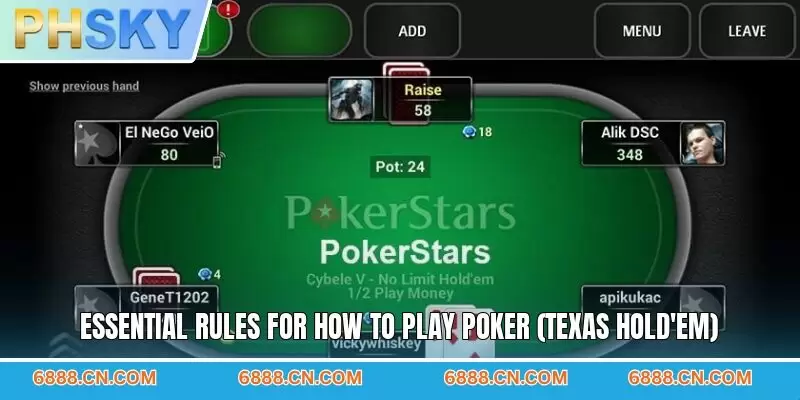
Essential rules for how to play poker (Texas Hold’em)
Before you start your first match at PHSKY, it’s essential to grasp the basic flow of how to play poker. Every round follows a structure that blends skill and chance, starting with bets, draws, and the eventual showdown.
Below are the main aspects every new player must know:
The objective and basic setup
The goal in Texas Hold’em is to win the “pot” (all chips bet in the hand). You win either by having the best five-card hand using any combination of your two private cards and five community cards, or by making all your opponents fold.
- The Dealer Button: A marker rotates clockwise after every hand, determining the positions of the Small Blind (SB) and Big Blind (BB), which are mandatory forced bets placed before any cards are dealt.
- Hole Cards: Each player is dealt two private cards, face-down. This is the start of learning play poker.
Standard poker hand rankings
The hierarchy of hands dictates the winner at showdown. Memorizing this ranking is non-negotiable for anyone learning how to play poker. From strongest to weakest:
- Royal Flush: A, K, Q, J, 10, all of the same suit. The absolute best hand.
- Straight Flush: Five cards in sequence, all of the same suit.
- Four of a Kind: Four cards of the same rank.
- Full House: Three of one rank, two of another (e.g., K-K-K-7-7).
- Flush: Five cards of the same suit.
- Straight: Five cards in sequence (e.g., 8-7-6-5-4).
- Three of a Kind: Three cards of the same rank.
- Two Pair: Two pairs of different ranks.
- One Pair: Two cards of the same rank.
- High Card: If no one makes a pair or better, the highest single card wins.
Betting round 1: Pre-Flop
This is the first round of betting. It begins after the two hole cards are dealt. The player sitting next to the Big Blind takes the first move. Your decision here is based solely on your two private cards and your position.
- Actions: Players can Call (match the Big Blind bet), Raise (increase the bet), or Fold (give up the hand). This is where strategic hand selection starts.
Betting round 2: The Flop
The dealer places three community cards face-up in the center of the table. These are available for all players to use in combination with their hole cards. This round begins with the player closest to the left of the Dealer Button (the Small Blind position, or the player who was SB).
- Actions: Players now have the additional option to Check (pass the action) if no bet has been made. Checking allows you to see the next card for free. If someone bets, subsequent players can Fold, Call, or Raise.
Betting round 3 and 4: The Turn and River
The Turn is the fourth community card dealt, followed by the third betting round. The River is the fifth and final community card dealt, followed by the final betting round.
In both these rounds, the betting structure and actions (Check, Bet, Fold, Call, Raise) remain the same as the Flop. These rounds are crucial for building the pot and executing bluffs.
The Showdown
If more than one player remains after the final betting round, the hand goes to the Showdown.
Players reveal their hole cards, and the pot is awarded to the player who can make the best five-card poker hand using any combination of their two hole cards and the five community cards. This concludes how to play poker for a single hand.
Smart habits and techniques that improve how to play poker

Smart habits and techniques that improve how to play poker
Understanding how to play poker is the foundation; the real challenge is playing profitably. These tricks are crucial for developing a strong strategic approach at PHSKY. Applying these methods consistently will dramatically improve your long-term results.
Master starting hand selection
This is the trick that separates winning players from losing ones. You should not play every hand. Playing a tight, aggressive game means you play fewer hands than your opponents, but when you do play, you enter the pot with a stronger range of cards.
Prioritize strong pairs (AA, KK, QQ), high suited cards (AKs, AQs), and big unsuited connectors (AK, AQ). Learning which hands to fold early saves you money and prevents you from making expensive mistakes post-flop. This is the simplest and most effective lesson in how to play.
Understand the power of position
Your position relative to the Dealer Button is your single greatest strategic advantage in poker. When you act last (on the Button), you have the benefit of seeing how all your opponents act before making your decision.
This information allows you to make more informed calls, place “bluffs” (bets with weak hands) to steal the pot when others check, or fold easily when the action indicates strong hands are held behind you. Conversely, playing from an early position is costly because you have no information.
Practice bankroll management
Your poker bankroll is the money you use specifically for playing, and it must be separated from your personal funds. The primary reason players fail in how to play poker is poor bankroll management, often by playing at stakes that are too high for their current funds.
You should aim to have at least 20 to 30 “buy-ins” for the cash game stake level you are playing. This cushion protects you from going broke during inevitable downswings. Never move up in stakes until you have successfully built a bankroll that can comfortably support the higher risk.
Conclusion
Mastering how to play poker is about balance – of skill, emotion, and calculation. Whether facing friends or global contenders at PHSKY, your patience and precision will define victory. Keep studying, refining, and experimenting with strategies. Once you own your decisions, poker becomes both art and science at your fingertips.
 Rhino Coin – Best Secret Hacks To Master The Savanna
  Pirots 4 Ignites A Treasure Hunt Adventure On PHSKY
  Jacks or Better Draw Poker – Essential PHSKY Skill Guides
  Ice Dragon King Awakens Fury Across Frozen Seas Tonight Now
  Fa Cai Shen Deluxe – Grab Your Share Of The Hidden Gold
  Crazy Blackbeard Brings A Wild Sea Adventure To PHSKY